Memento mori calendar
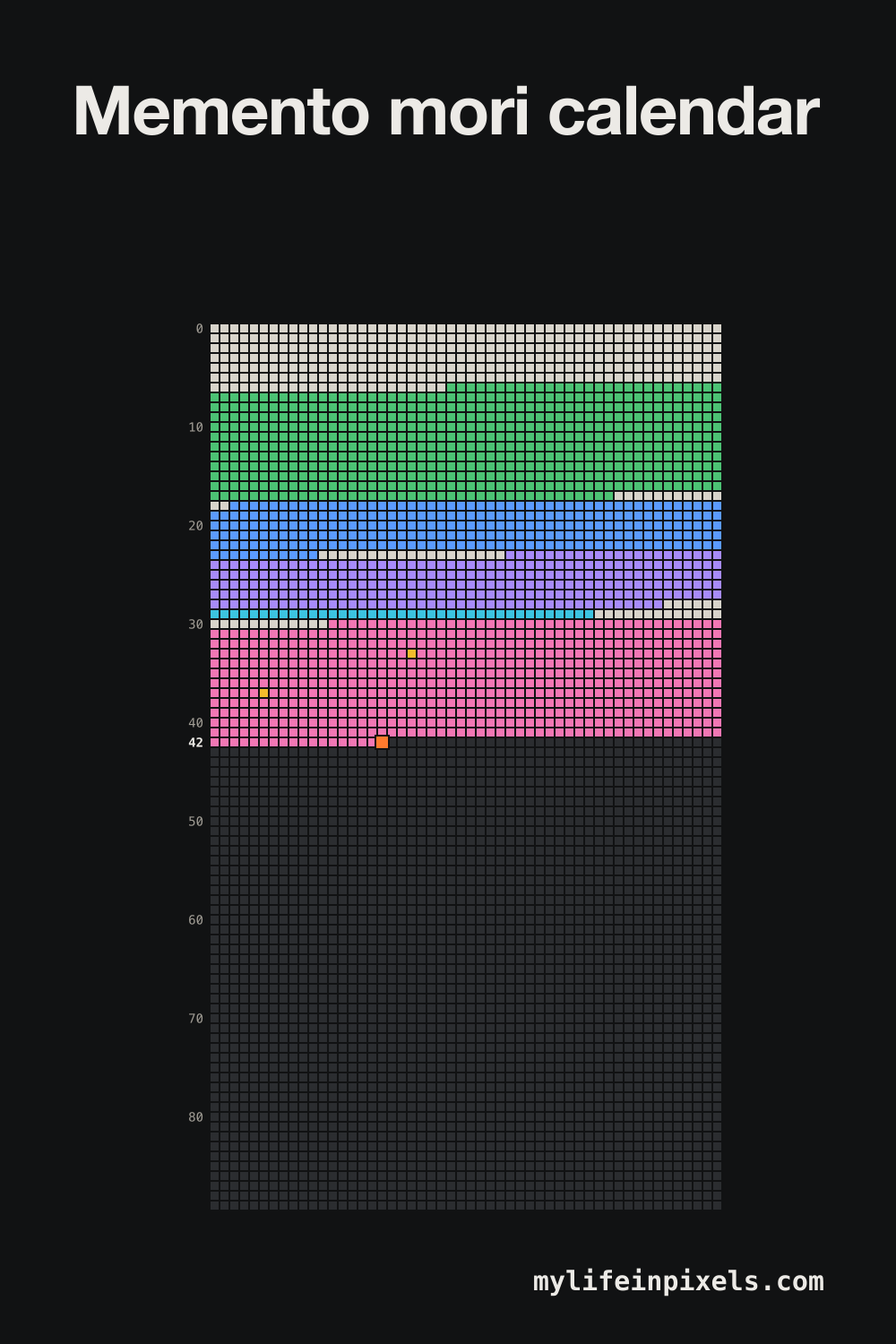
A memento mori calendar shows your whole life as a grid of weeks, with the weeks already lived filled in. Memento mori is Latin for "remember that you will die". The Stoics used the thought to decide what deserves their time, not to be gloomy. Fill in your date of birth below to see yours.
You've used ?% of your life.
Answer both questions and watch your weeks fill in.
- weeks lived
- ?
- weeks until 90
- ?
Click a week to see its date. Drag across weeks to color a period.Tap a week to see its date. Press and hold, then drag, to color a period.
Use the arrow keys to move between weeks, hold Shift to select a period, and press Enter to add a milestone.
Milestones
No milestones yet. Color in your studies, jobs, relationships, children or moves.
What is a memento mori calendar?
It is a life calendar with a purpose. The grid is the same as any life in weeks chart: 52 columns, one row per year, the lived weeks filled in. What makes it a memento mori calendar is how you use it: as a regular, calm reminder that the number of boxes is finite, so that the next box gets spent on something you chose.
The modern grid comes from Tim Urban’s essay “Your Life in Weeks” (Wait But Why, 2014). The idea behind it is about two thousand years older.
What did the Stoics mean by it?
The Stoics did not treat death as a dark subject to avoid. They treated it as a fact to reason from. Seneca, in his letters and in “On the Shortness of Life”, argues that life is long enough if you stop giving it away to things that do not matter, and advises closing the accounts of each day as if it could be the last. Marcus Aurelius, writing notes to himself as emperor, keeps returning to the same instruction: you could leave life at any moment, so let that settle what you do and say now. Epictetus tells his students to keep death in view daily, so that they never want anything too much or fear anything too much.
In none of these texts is the conclusion sadness. The conclusion is priority. If time is limited, then postponing what matters is the real waste.
How do you use the calendar without making it gloomy?
- Look back first. Color in the periods of your life so far. Most people are surprised by how much is already on the grid.
- Mark what you are glad about. The milestones you add are a record of what you did with your weeks.
- Use the empty part for one decision. Not a bucket list of fifty items; one thing you would regret leaving out.
- Keep the rhythm light. A glance once a week is enough. The calendar is a reminder, not an assignment.
Why weeks?
Years are too coarse: there are only 90 of them and one looks much like another. Days are too fine: 32,873 boxes do not fit on a screen and no single day feels decisive. A week is the smallest unit you can still plan and still remember, and 4,680 of them fit on one page. That is why both Tim Urban’s grid and Oliver Burkeman’s book “Four Thousand Weeks” (2021) settle on weeks.
For the numbers, see how many weeks are in a lifetime. For a version to hang on the wall, see the life calendar poster.
Frequently asked questions
What does memento mori mean?
Memento mori is Latin for "remember that you will die" or "remember that you are mortal". It is a reminder to live deliberately, used by Stoic philosophers and later in Christian art, where skulls, hourglasses and wilting flowers carried the same message.
Is a memento mori calendar morbid?
Most people find the opposite. The calendar does not show how you die; it shows how much life there is and what you did with it so far. The point of the exercise is the empty boxes, which are still yours to fill.
How many weeks does a memento mori calendar have?
The usual version has 4,680 weeks: 52 weeks per year for 90 years. Shorter versions use 80 years, which is 4,160 weeks. My Life in Pixels lets you choose any length from 70 to 100 years.
Which Stoics wrote about memento mori?
Seneca returns to the theme throughout his letters and in "On the Shortness of Life". Marcus Aurelius reminds himself of it repeatedly in the "Meditations", and Epictetus teaches it in the "Discourses" and the "Enchiridion". The Latin phrase itself is later than all three.
How often should I look at the calendar?
Once a week is a natural rhythm, since one box is one week. Some people keep a printed version on the wall; others open the grid on their birthday or at New Year and update their milestones.
Last updated: